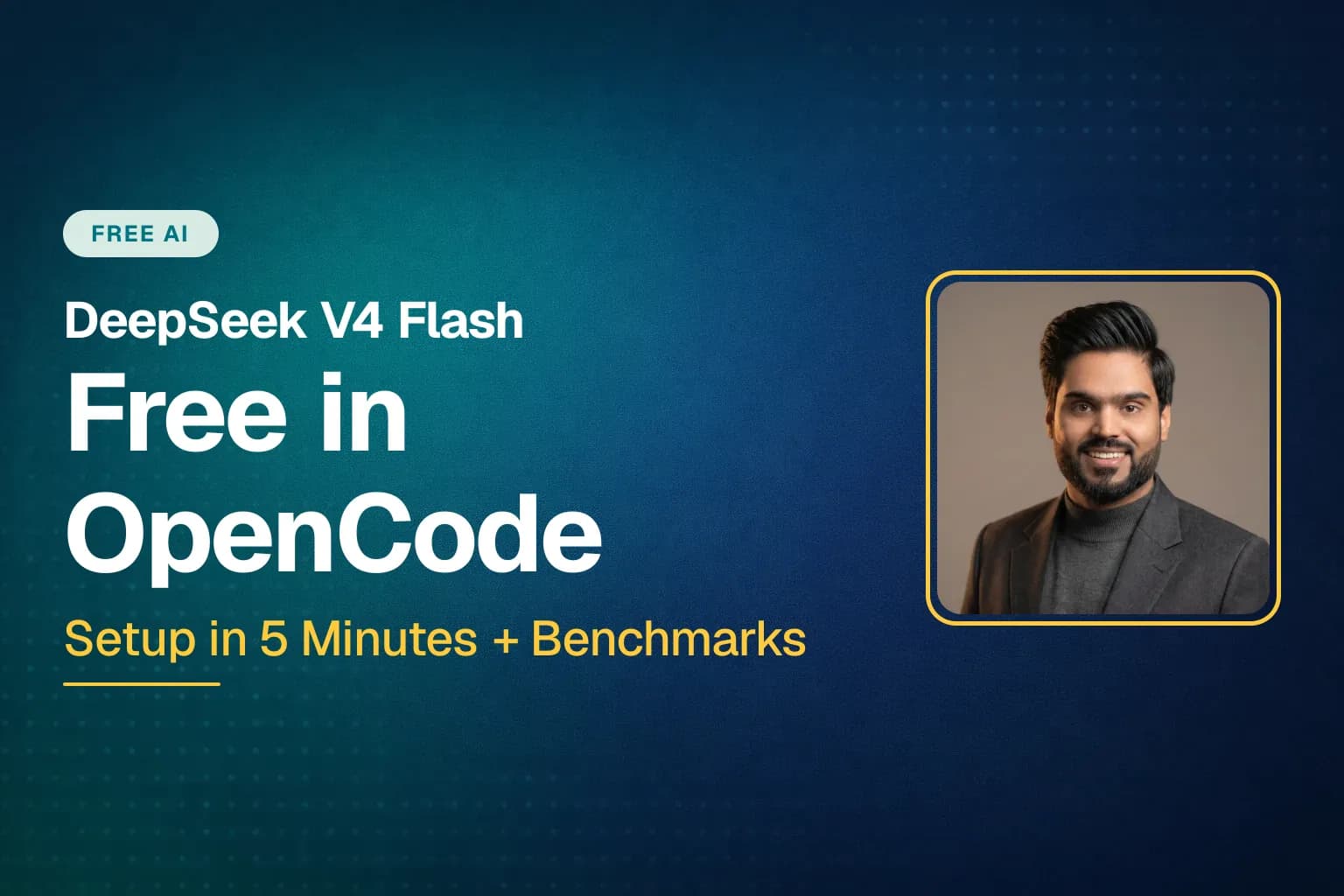
A free model that ranks third in the world for intelligence sounds like marketing. In 2026, it's real: DeepSeek V4 Flash scores 50 of 100 on the Artificial Analysis Intelligence Index, placing it #3 of 101 models (Artificial Analysis, 2026). It's also free inside OpenCode, the open-source AI coding assistant. No credit card. No paid plan. You can be running it in five minutes.
Most developers still think frontier-quality AI needs a $20/month subscription. DeepSeek's release changes that math, and it changes what you can build with free tooling. This guide shows exactly how to set it up, what I actually built with it, and where it still falls short. I tested it on real work: a pull request, a full blog article, and a writing workflow. You get verified results, not a spec sheet.
Key Takeaways
- DeepSeek V4 Flash is free in OpenCode with no credit card — a free login is the only requirement.
- It ranks #3 of 101 on the Artificial Analysis Intelligence Index at $0.03 per task, versus $3.15 for Claude Fable 5.
- It wrote a real PR and a full blog article for me — with 2–3 prompt iterations and a proofreading pass.
- Watch out for 200K free-tier context and occasional 503 errors at peak hours.
Is DeepSeek V4 Flash Really Free?
Yes, and this is the part that sounds too good to be true. OpenCode's free tier serves deepseek-v4-flash-free directly in the model picker, with no credit card and no paid plan attached (OpenCode, 2026). Signing in with a free account is the only requirement. The free model runs a 200K-token context window, plenty for coding tasks and article drafting.
The free tier is time-limited rather than permanent. OpenCode has run free-model promotions before, and DeepSeek V4 Flash Free is one of them. Treat it as "free right now," not "free forever." The model itself isn't going anywhere. If you outgrow the free tier, the same model costs $0.14 per million input tokens and $0.28 per million output tokens on DeepSeek's API. Effectively pennies per task (DeepSeek API Docs, 2026).

The honest framing: free today, dirt cheap forever. The free tier exists to get you hooked on a model that already undercuts every frontier competitor on cost. Not a bad deal for either side.
Why the Hype Is Justified — The Benchmarks
In July 2026, DeepSeek moved V4 Flash out of preview and the numbers landed near the top of every major leaderboard. The model scores 50/100 on the Artificial Analysis Intelligence Index, ranked third of 101 models (Artificial Analysis, 2026). That's a tie with Gemini 3 Flash, one point behind GLM-5.2 and Muse Spark 1.1.
DeepSeek V4 Flash lands at #3 of 101 models, tied with Gemini 3 Flash.
Here's the number that matters more than rank: cost per task. Artificial Analysis measures what a benchmark run actually bills, and DeepSeek V4 Flash costs $0.03 per task (Quartz, 2026). Kimi K3 runs $0.86. GPT-5.6 Sol runs $1.86. Claude Fable 5 runs $3.15. That's a 100x gap to the top of the cost chart.
DeepSeek's bar is drawn at minimum height for visibility; at true scale ($0.03) it would be roughly two pixels tall.
Speed holds up too. DeepSeek V4 Flash generates around 104 output tokens per second, ranked #12 of 101 models (Artificial Analysis, 2026). Comfortably inside the fast tier, while Opus-class models sit lower. Responses come back quickly enough that interactive agent work doesn't feel like waiting. Who needs a $20 subscription when the free model holds rank with models that cost $100 a month?
Model Comparison Table
| Model | Provider | Intelligence¹ | Price in/out ($/1M) | Context² | Speed (t/s)³ | Cost/task |
|---|---|---|---|---|---|---|
| ★ DeepSeek V4 Flash 0731 | DeepSeek | 50 (#3/101) | $0.14 / $0.28 (cache $0.003) | 1M (200K free) | ~104 | $0.03 |
| Gemini 3 Flash | 50 | $1.50 / $7.50 | 1M | ~188 | ~$0.25⁴ | |
| Muse Spark 1.1 | Meta | 51 | $2.00 / $6.00 | 1M | — | ~$0.5⁴ |
| GLM-5.2 | Z.AI | 51 | $0.30 / $1.20 | 1M | — | ~$0.2⁴ |
| Kimi K3 | Moonshot | 57 | $3.00 / $15.00 | 1M | ~38 | $0.86 |
| Claude Opus 5 (max) | Anthropic | ~61 | $5.00 / $25.00 | 1M+ | — | ~$1.2⁴ |
| GPT-5.6 Sol | OpenAI | —⁵ | $5.00 / $30.00 | 1M | — | $1.86 |
| Claude Fable 5 | Anthropic | ~83⁶ | $10.00 / $50.00 | 1M+ | — | $3.15 |
¹ Artificial Analysis Intelligence Index (higher = better). ² Context window in tokens, full paid model. ³ Output tokens per second (Artificial Analysis). ⁴ Estimate based on comparable models. ⁵ Not yet listed on Artificial Analysis at writing. ⁶ Fable 5 score from BenchLM's 100-point scale — not directly comparable to the AA index.
The verdict on this table is simple: if you want work done free today, DeepSeek V4 Flash is the only answer on it. For pure intelligence, Claude Opus 5 wins, but at $5–$25 per million tokens that's for high-stakes work, not daily coding. In 2026, the intelligence-to-cost ratio is the story, and nobody else on that table comes within an order of magnitude.
How to Get DeepSeek V4 Flash Free in OpenCode
OpenCode is a free, open-source AI coding assistant that runs in your terminal. Think Claude Code, but model-agnostic and with a free tier (OpenCode, 2026). Setup takes about five minutes:
- Install OpenCode. Open a terminal and run
curl -fsSL https://opencode.ai/install | bash, or install it with npm:npm install -g opencode. Verify withopencode --version. - Launch it. Type
opencodein your terminal (or in VS Code's built-in terminal, which is where I run it). - Pick the model. Run
/modeland select DeepSeek V4 Flash Free from the list. It also shows asopencode/deepseek-v4-flash-freein headless mode. - Verify. Send a small prompt like "write a Python function that reverses a string." If you get a reply, you're running on DeepSeek V4 Flash.
curl -fsSL https://opencode.ai/install | bash
opencode
/model   # → select "DeepSeek V4 Flash Free"
Setup checklist
- OpenCode installed (
opencode --version)- Terminal launched,
opencoderunning/model→ DeepSeek V4 Flash Free selected- Test prompt answered correctly
The model picker lists other free models too, including Kimi K3 if you connect it with an API key. More on that below. And because OpenCode runs a full agent loop, not just autocomplete, you can hand it multi-file tasks the same way you would Claude Code. If you're new to agent-driven workflows, our guide to agent skills explains how reusable skill files make these tools dramatically more effective.

What Can You Actually Build With It?
This is where the model stops being a spec sheet. I used DeepSeek V4 Flash for real deliverables over the past weeks, and the results changed how I work. Here's what came out of it:
- A production pull request. I handed it a client coding task in OpenCode. It created the code, tests, and a sensible commit history; I reviewed, tweaked, and merged. The quality held up on the first pass.
- A full blog article. I had it draft our Claude Code vs Cursor comparison, then ran two or three prompt iterations and applied a professional proofreading pass. The published post is the result of that workflow.
- Writing workflows. For social media copy, emails, and blog drafts, a strong draft plus humanizer and proofreader passes produces work I'm comfortable publishing under my name.
The benchmarks back the hands-on experience. In the July 2026 release, Terminal-Bench 2.1 jumped 20.9 points to 82.7, above the V4 Pro preview, the flagship of its own family, and agentic benchmark reports put SWE-bench around 79% (Noze, "DeepSeek V4 Flash 0731" analysis, 2026). Those numbers were measured on DeepSeek's own test rig, so treat them as directional. The point stands: this is a coding agent, not a chatbot with a code mode.

The workflow lesson is worth more than the model choice: free models reward good process. The gap between a mediocre result and a publishable one was my prompt iterations and a proofreading pass, not a model upgrade. For a deeper look at the reusable workflows that make agent output consistent, our roundup of the best Claude Code plugins covers the same skill-driven approach.
What Are the Limitations?
Free doesn't mean flawless, and you should know what you're trading. The free tier runs a 200K-token context window; the paid model supports 1M tokens. Very long codebases or giant prompts will hit a wall (OpenCode, 2026). That matters less than you'd think for day-to-day agent work, but a 300-file refactor is out of reach on the free tier.
The bigger practical issue is availability. I've hit 503 errors at peak hours. DeepSeek's API gets saturated, and OpenCode tells you to wait and retry. It resolves on its own within minutes, but it's a real friction point if you're mid-task at a busy time. When a model is this cheap, this many people are using it.
Would you run a production pipeline on a free tier? Probably not, and you don't need to. The model's strength is that free is a perfect trial: you validate whether it fits your workflow at exactly zero cost, then decide if the paid path is worth it. And at $0.03 per task, "paid" is still cheaper than a coffee.
Taking It Further — API Key, Claude Code, and Kimi K3
The free tier is the appetizer. The full setup unlocks the same model everywhere else, and the economics stay trivial. Grab a DeepSeek API key from the DeepSeek platform, and you can plug it into Claude Code (via DeepSeek's Anthropic-compatible endpoint), Cursor, OpenClaw, or any OpenAI-compatible client (DeepSeek API Docs, 2026). At $0.14 input / $0.28 output per million tokens, with cached input at $0.003, a typical agent task bills at fractions of a cent. If you already run Claude Code, the same Model Context Protocol plumbing that connects your tools connects an alternative model just as easily.
What about Kimi K3? It's the other model worth knowing in OpenCode. Moonshot's K3 scores 57 on the Intelligence Index, ahead of DeepSeek V4 Flash, with strong multimodal and frontend capabilities (Quartz, 2026). You can add it in OpenCode with a /connect step and a Moonshot API key. It has its own load issues, though: I've hit 503 errors with Kimi K3 too, and it bills around $3/$15 per million tokens, about 20x DeepSeek's price. For frontend-heavy work, it's genuinely strong; for everything else, DeepSeek V4 Flash remains the value pick.
Frequently Asked Questions
Is DeepSeek V4 Flash really free?
Yes. OpenCode's free tier serves it with no credit card and no paid plan — a free login is the only requirement. The free model runs a 200K-token context window, while the paid API unlocks the full 1M-token model for $0.14 per million input tokens (OpenCode, 2026).
Is DeepSeek V4 Flash good for coding?
Yes for most real work. It scores 50/100 on the Artificial Analysis Intelligence Index (#3 of 101) and jumped 20.9 points to 82.7 on Terminal-Bench 2.1 in the July 2026 release (Noze, "DeepSeek V4 Flash 0731" analysis, 2026). The caveats: a smaller free-tier context window and occasional 503s at peak hours.
Can I use DeepSeek V4 Flash in Claude Code?
Yes. DeepSeek serves an Anthropic-compatible endpoint, so Claude Code can point at it with an API key. At $0.14/$0.28 per million tokens, a task costs a few cents — a fraction of Claude's own pricing (DeepSeek API Docs, 2026).
How much does DeepSeek V4 Flash cost per task?
$0.03 per benchmark task, per Artificial Analysis — versus $0.86 for Kimi K3, $1.86 for GPT-5.6 Sol, and $3.15 for Claude Fable 5 (Quartz, 2026). It's the cheapest major AI model to run in 2026.
The Bottom Line
DeepSeek V4 Flash is the first genuinely free frontier-tier coding model, and it's worth trying this week:
- Free in OpenCode: no credit card, five-minute setup.
- #3 of 101 on intelligence at $0.03 per task: a 100x cost gap to the leaders.
- Proven on real work: a merged PR and a published article from my own testing.
- Honest limits: 200K free context, peak-hour 503s, and a time-limited free tier.
Start with the free tier in OpenCode today. If the results hold up on your work, the API path costs less than a coffee per week, and you've kept a full Claude or GPT subscription for the tasks that genuinely need it. Watch the walkthrough video above, then tell me what you build with it. Want to go deeper on AI-driven workflows? Start with our guide to agent skills, or explore LWS Academy courses to turn this into a repeatable system.
Read more
Claude Code vs Cursor (2026): Which Is Better?
Claude Code vs Cursor in 2026: 84% of developers use AI coding tools, but which fits your workflow? We tested both on real client work for the verdict.
What Are Agent Skills? A Developer's Guide to Reusable AI Workflows
Agent Skills let you package reusable prompts as slash commands in Claude Code. Learn how SKILL.md files work, where they live, and how to build your first skill.
What Is MCP (Model Context Protocol)? A Complete Guide
MCP hit 97M+ monthly SDK downloads and 10,000+ servers in one year. Learn how the Model Context Protocol works and why every major AI company adopted it.